
University of Virginia: School of Data Science Embraces Open Practices in Faculty Research and Evaluation
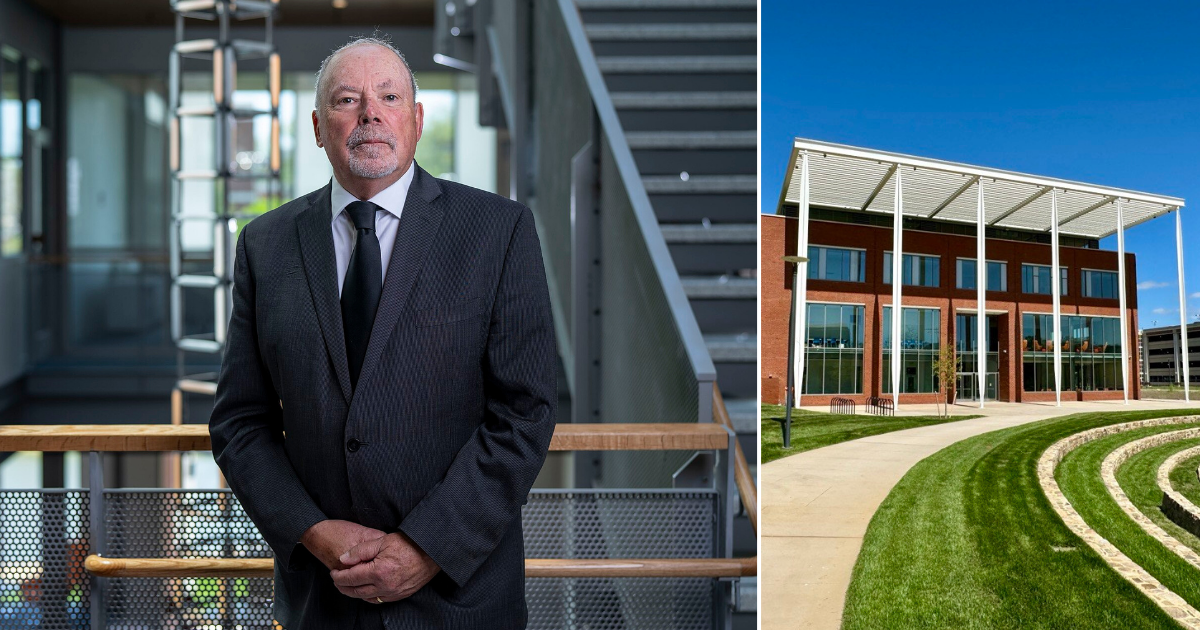
Left: Phil Bourne, whose leadership helped establish openness as a core value at UVA's School of Data Science. Photo by Sanjay Suchak (CC BY 4.0).
Right: University of Virginia School of Data Science. Photo courtesy of the School of Data Science (CC BY 4.0).
When the University of Virginia established a School of Data Science (SDS), founding dean Phil Bourne focused on openness as a core value to be woven through all its work. From his arrival at UVA in 2017 to his passing in 2026, Bourne, a distinguished bioinformatician and former data science leader at the National Institutes of Health, promoted open practices and policies. His commitment left a lasting mark on campus, particularly in the faculty’s approach to research.
In 2021, the SDS adopted guidelines calling on faculty to make all scholarly articles, papers, books, data, and software openly available, free of charge in formats that allow reuse with CC 0 or CC BY licenses. It emphasized how transparency allows scholars to innovate, build on each other’s research, and accelerate science.
Prior to those guidelines being issued, UVA had a copyright ownership policy in place in which the university retains a license to make non-commercial uses of all scholarly works produced by employees of the university. This allowed the SDS to build on the university’s existing rights rather than create a new license as part of its OA guidelines.
The SDS created clear signals to faculty members that openness was truly embraced by aligning its hiring, promotion, and tenure policies with the open access guidelines. UVA also supports these signals through its library operated institutional repository, and its open access press, Aperio.
During the hiring process, all SDS candidates are asked on their application to provide details about their open research and open publishing practices. Faculty members are further instructed in the advancement process that “Promotion and tenure materials should describe steps taken to ensure reproducibility of results, including transparent reporting of methods, sharing of materials, and the use of tools that support computational reproducibility.”
[See 2020 SDS Promotion and Tenure Policy]
“There was no greater champion for openness than Phil,” said Lane Rasberry, Wikimedian in Residence at UVA’s School of Data Science. While a new dean has yet to be appointed, Bourne’s legacy lives on through the policies he helped establish, the work of faculty, and ideas that he promoted.
The SDS essentially operates as a “school without walls,” Rasberry said, welcoming students from all backgrounds and abilities to develop practical skills that could benefit the community. At the school, students can earn a bachelor’s degree, master’s degree and Ph.D.
“We hear a lot about silos in open conversations,” Rasberry said. “The SDS wants people from other schools to take classes here – from the humanities and social sciences to STEM disciplines – anyone can get a toolkit and back to their disciplines.”
Faculty, too, are devoted to community outreach. Those who produce software tools or any digital media resources make their licenses open for use to others beyond the school. Many researchers partner with local nonprofits to translate their work for broader application.
Jonathan Kropko, associate professor in the UVA School of Data Science, works to bridge technology and data in service to the community.
“The tech industry is considered very wealthy, yet many products, tools, models and data sets are free to use,” he said. “What’s needed is the knowledge of how to use them.”
Kropko also runs Code for Charlottesville, a volunteer group that collaborates with organizations on tech projects to benefit the public. Among many other community contributions, Code for Charlottesville has helped Meals on Wheels integrate new open-source software into its operations to streamline services and has built chatbots and conducted data analysis for local legal aid nonprofits. Kropko is also conducting research on the public interest technology movement and on the best ways to get successful outcomes with this engagement.
His efforts on Code for Charlottesville are valued by the SDS in his professional evaluation, which is something that Kropko appreciates after having started his career in the UVA Department of Politics, where the expectation was to publish in traditional journals.
After moving to SDS in 2019, Kropko was motivated to explore open access publishing and got an article published in PLOS One. “That article is by far my most cited work,” he said. “For me personally, that experience was very illuminating.”
Now, Kropko has plans to start an open access journal for the national civic technology community featuring case studies. He’s also developed his own open textbook from scratch for students in the SDS online master’s program. Not only does this reduce costs for students, Kropko was able to customize the content. “I love the ability to knit together text, code and the results of code in one, linear document,” he said. [See his OER book, Surfing the Data Pipeline with Python] The SDS works closely with the staff at the UVA library to advance and promote open practices. Faculty put papers and data sets in the campus institutional repository for easy, free access to the public. A data librarian helps professors understand open access publishing options and SDS staff person helps people register an ORCID iD https://orcid.org/ and build a profile to make their work easily discoverable.
While a solid foundation has been established at the SDS, Rasberry says there is much more to do to educate others about open practices. Still, he said he’s hopeful and convinced that leveraging open practices is the key to solving the most pressing societal problems and that faculty evaluation at SDS reflects that.
Founding Dean Phil Bourne’s contributions helped to establish this culture that meaningfully recognizes open sharing, and the School of Data Science remains well-positioned to carry that legacy forward in the work it supports driven by this culture.
[For more, see news story from SPARC: UVA School of Data Science Sets Example for Campus on Open Access]
#